

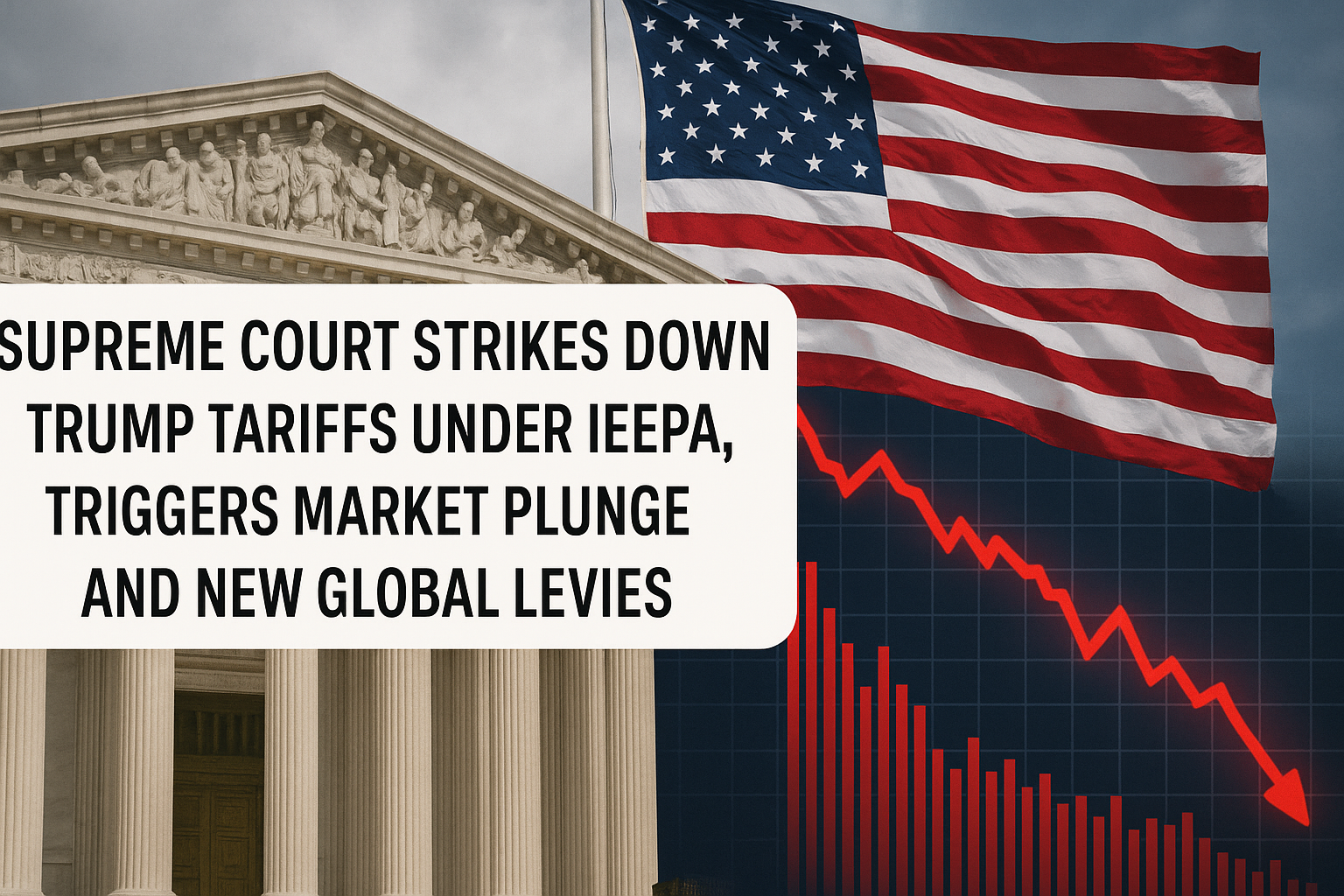
Feb. 23, 2026 — Washington — The U.S. Supreme Court ruled 6-3 on Friday that President Trump’s sweeping tariffs imposed under the International Emergency Economic Powers Act (IEEPA) exceeded presidential authority, requiring congressional oversight for such trade actions. Chief Justice John Roberts, in the majority opinion for Learning Resources, Inc. v. Trump, held that “the Constitution vests the tariff power in Congress, not the executive branch,” applying the major questions doctrine due to the tariffs’ vast economic significance.
The decision strikes down tariffs on nearly all imports, potentially exposing over $175 billion in collected revenue to refunds, according to the Penn-Wharton Budget Model. The Court remanded cases for lower courts to address invalidation and refunds, creating uncertainty for importers and the U.S. Treasury.
President Trump immediately criticized the ruling as a “disgrace” and “ridiculous, dumb,” posting on social media that the justices showed a “complete lack of respect.” He pivoted to Section 122 of the 1974 Trade Act, imposing a 10% global tariff on most imports, which he raised to 15% the next day. The authority allows levies for only 150 days without congressional approval. U.S. Trade Representative Jamieson Greer stated the administration’s “policy hasn’t changed,” using “durable tools” like Section 301 investigations.
U.S. stocks plunged Monday amid tariff uncertainty. The Dow Jones Industrial Average dropped 794 points, or 1.6%, as of midday. The S&P 500 fell 78 points, or 1.1%, and the Nasdaq declined 1.3%, with financials like JPMorgan leading losses alongside AI sector concerns.
The ordinary meaning of the key statutory term in IEEPA—the word ‘regulate’—is capacious… But that is not enough to sustain the President’s claim because the statute does not ‘clear[ly]’ grant him the ‘extraordinary’ delegated power he seeks.
— Chief Justice John Roberts, majority opinion
Internationally, the EU Parliament’s trade committee froze ratification of its U.S. trade deal, with chair Bernd Lange citing rates now “much higher than the 15 percent in the old agreement.” Indian trade officials postponed a trip to finalize an interim deal.

The ruling, joined by Justices Sotomayor, Kagan, Gorsuch, Barrett, and Jackson in parts, drew dissents from Justices Thomas, Kavanaugh, and Alito, who argued IEEPA complied with historical practice. Markets and trade partners await refund processes and potential congressional challenges.