

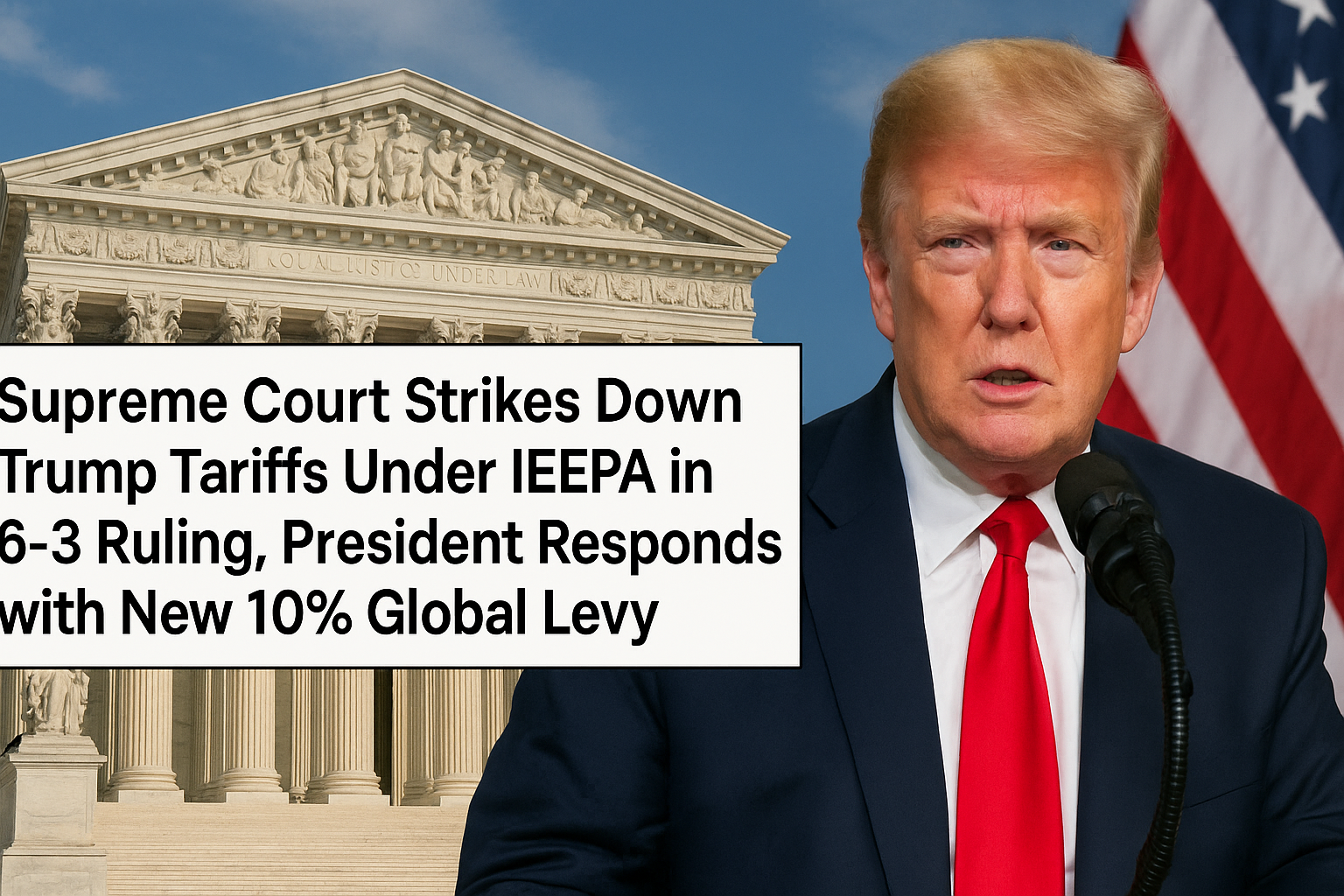
Feb. 20, 2026 — Washington, D.C. The U.S. Supreme Court ruled 6-3 in Learning Resources, Inc. v. Trump (No. 24-1287) that President Donald Trump’s use of the International Emergency Economic Powers Act (IEEPA) to impose sweeping global tariffs exceeded his authority, invalidating key parts of his second-term tariff program and disrupting his economic agenda.
Chief Justice John Roberts delivered the opinion of the Court with respect to Parts I and II–A–1, joined by Justices Sotomayor, Kagan, Gorsuch, Barrett, and Jackson. The Court held that IEEPA’s provision to “regulate . . . importation” does not authorize tariffs, a core congressional taxing power under Article I, Section 8, lacking explicit statutory language.
“Based on two words separated by 16 others in … IEEPA—‘regulate’ and ‘importation’—the President asserts the independent power to impose tariffs on imports from any country, of any product, at any rate, for any amount of time,” Roberts wrote. “Those words … cannot bear such weight.”
The splintered decision invoked the major questions doctrine, requiring clear congressional authorization for such significant actions. Justices Gorsuch and Barrett concurred in parts, while Justices Kagan and Jackson filed separate concurrences emphasizing textual limits. Justice Brett Kavanaugh dissented, joined by Justices Thomas and Alito, arguing IEEPA historically includes tariffs as a means to regulate importation.
“The tariffs have generated vigorous policy debates. But such debates … are not for the Federal Judiciary to resolve,” Kavanaugh wrote.
In response, Trump called the ruling “terrible” and “deeply disappointing,” labeling dissenting justices as “fools and lap dogs” and expressing shame over Republican appointees. He signed an order winding down the invalidated tariffs and imposed a new 10% global tariff under Section 122 of the 1974 Trade Act, effective Feb. 24, with exemptions for Canada and Mexico under USMCA, certain foods, minerals, and pharmaceuticals. Trump later announced plans to raise it to 15%.
The decision introduces uncertainty over refunds for over $200 billion collected and ongoing trade deals. The EU paused ratification of a U.S.-EU trade deal capping tariffs at 15%, while India delayed trade talks.

Businesses welcomed relief but braced for new levies, with markets rising post-announcement. The White House indicated refunds face litigation, potentially lasting years.