

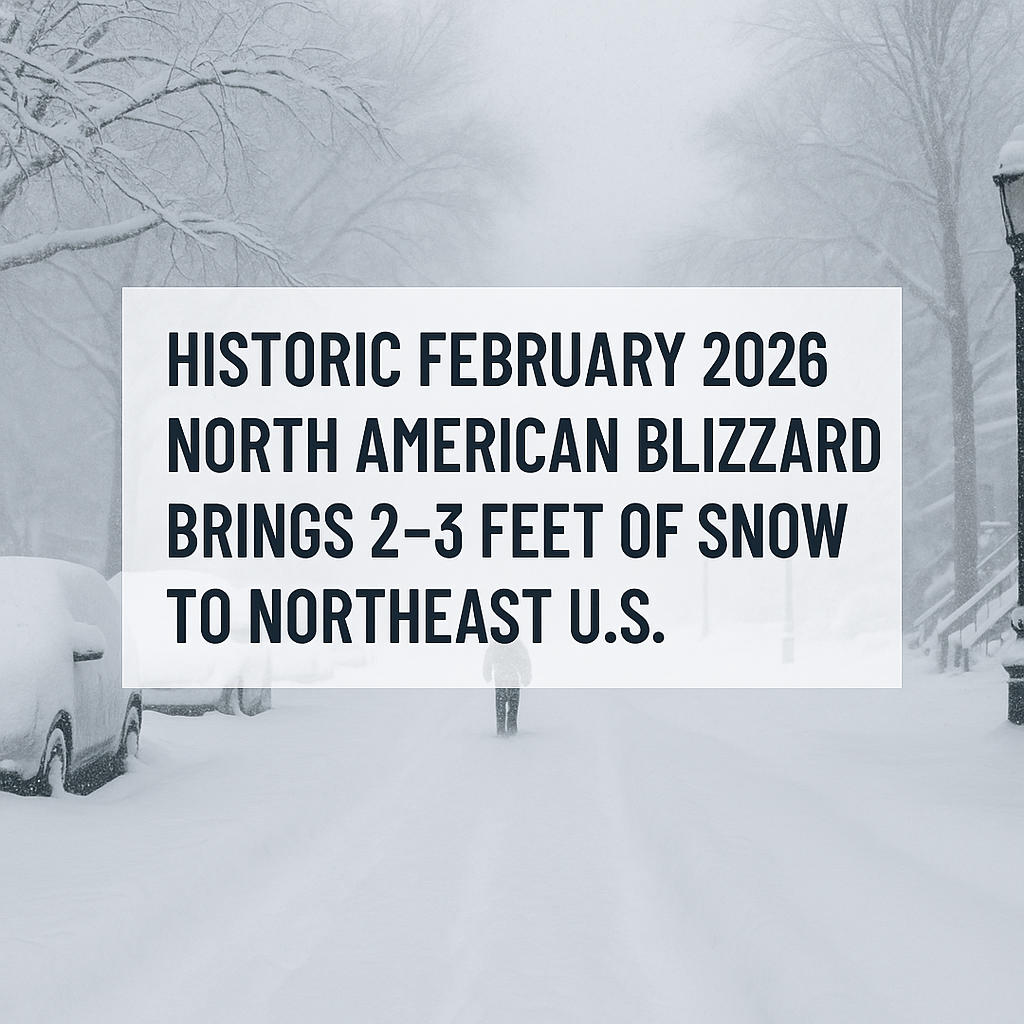
Feb. 23, 2026 — Northeast U.S. A historic nor’easter, dubbed the February 2026 North American blizzard or Bomb Cyclone Hernando, battered the Northeast megalopolis starting February 22, 2026, dumping 2-3 feet of snow across New York City, New Jersey, Long Island, and parts of Massachusetts due to explosive cyclogenesis.
Blizzard conditions with sustained winds up to 75 mph and gusts reaching 98 mph at Wellfleet, Massachusetts, caused widespread whiteouts, power outages affecting over 600,000 customers primarily in New Jersey and New York, and more than 9,900 flight cancellations nationwide, including nearly 1,000 at New York-area airports like JFK, LGA, and EWR. States of emergency were declared in New Jersey, New York, and portions of New England, with over 40 million people under blizzard warnings from New Jersey to Massachusetts.
Snow-covered benches in Brooklyn, New York during the blizzard, as shared in social media updates.
Snow totals reached record levels, including 36 inches in Providence, Rhode Island, 33.5 inches in East Providence and North Kingstown, Rhode Island, 27.9 inches in Carlstadt, New Jersey, and 22-24 inches on Long Island. New York City areas saw 15-22 inches, with Central Park at 19.7 inches, LaGuardia Airport at 22.2 inches, and JFK at 19.8 inches. The storm marked New York City’s first blizzard warning in nearly a decade.
Travel disruptions were severe, with major airports shuttered, I-95 corridor shutdowns, and non-essential travel bans in New York City, southern Massachusetts, and New Jersey. Massachusetts Governor Maura Healey imposed a statewide travel ban on non-essential vehicles along the southern coast, while a 40 mph speed limit was set on the Massachusetts Turnpike. Road conditions remained life-threatening with near-zero visibility, and plow operations struggled amid ongoing snowfall.
Power outages peaked with Massachusetts hardest hit at over 282,000 customers affected, followed by New Jersey (93,000+), Delaware (61,000+), and Rhode Island (42,000+). Coastal flooding impacted shorelines, and at least two fatalities were reported, including one from a tree falling on a car in Maryland.

Meteorologically, the storm originated from a shortwave trough on the West Coast on February 19-20, rapidly intensifying off North Carolina on February 22 to 966 mb by February 23, producing heavy snowbands, thundersnow, and hurricane-force gusts. It compared to past mega-storms but featured extreme urban totals.
Governors in seven states issued emergency declarations as the storm loosened its grip on February 23, though additional snow and icy roads were expected. Officials urged avoiding travel amid refreezing conditions.