

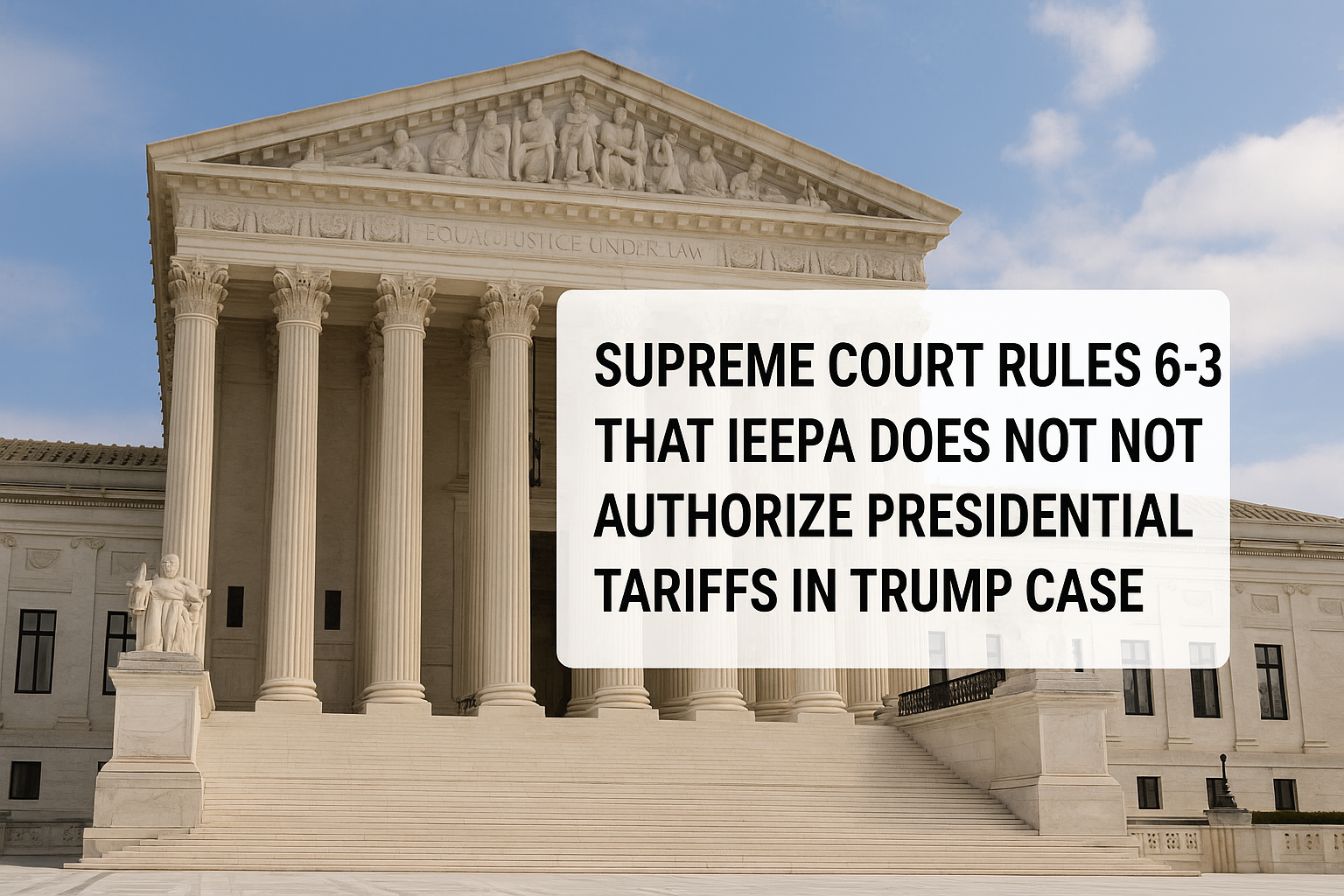
Feb. 20, 2026 — Washington, D.C. The U.S. Supreme Court held 6-3 in Learning Resources, Inc. v. Trump (Nos. 24-1287 and 25-250) that the International Emergency Economic Powers Act (IEEPA) does not authorize the President to impose tariffs, ruling the statute lacks explicit language for such revenue-raising measures and violates separation of powers under Article I.
Chief Justice John Roberts authored the principal opinion, emphasizing the major questions doctrine and textual limits on the power to “regulate…importation.” A splintered majority included Justices Sotomayor, Kagan, and Jackson on statutory grounds, according to SCOTUSblog.
Roberts wrote in the opinion:
“Based on two words… ‘regulate’ and ‘importation’—the President asserts the independent power to impose tariffs… Those words cannot bear such weight.”
Justice Kavanaugh dissented, arguing tariffs are a form of regulation in foreign affairs.
The decision notes no prior presidential use of IEEPA for tariffs and raises the potential for more than $200 billion in refunds, with Reuters estimating $175 billion.

U.S. Supreme Court building in Washington, D.C., where the ruling was issued.
In response, President Trump called some justices a “disgrace” and imposed a new 10% global tariff under alternative authority, later reportedly raised to 15% in some contexts, creating uncertainty for global trade Wall Street Journal BBC New York Times AP News.
Markets initially rallied in relief before concerns over the new tariffs caused whiplash CNBC. The ruling invalidates IEEPA-based tariffs but spares those under other laws NBC News.
A The Hill poll showed a majority of Americans approving the decision. Social media on X reflected high engagement, with posts from Reuters on Trump’s trade warnings and Fox News linking the ruling to other issues outpacing other stories X post.
Additional coverage from NPR, Washington Post, Bloomberg, Politico, Fortune, and CNN confirmed the 6-3 vote, IEEPA limits, and Trump’s workaround tariffs.