

Feb. 24, 2026 — Northeast United States A historic nor’easter, dubbed Winter Storm Hernando by The Weather Channel, pummeled the Northeast from February 22 to 24 with 2 to 3 feet of snow in many areas, hurricane-force wind gusts up to 98 mph, and blizzard warnings for over 40 million people, leading to widespread travel bans, more than 5,700 flight cancellations, and over 600,000 power outages.
The storm, described as one of the worst since 1996, broke snowfall records including 37.9 inches at Rhode Island T.F. Green International Airport in Providence—the highest two-day total surpassing the 1978 blizzard—and 31 inches in Islip, New York, per NBC News live updates and the Washington Post. Other totals included 32.8 inches in Providence, 29.1 inches in Islip, 27 inches in Newark, New Jersey, and 19.7 inches in New York City’s Central Park.
Travel disruptions were severe: New York City enacted its first travel ban in over a decade, later lifted, while bans persisted in parts of Rhode Island, Massachusetts, New Jersey, and Connecticut. Over 8,000 flights were canceled at major airports like JFK, LaGuardia, Newark, and Boston Logan, with more than 30 Amtrak trains halted. States of emergency were declared in seven states, including New York and New Jersey.
“This is the biggest snowstorm that we’ve ever seen, and the blizzard conditions will only complicate that,” Rhode Island Gov. Daniel McKee said, urging residents to stay off roads.
“Though the travel ban has lifted, conditions on the road are still icy and dangerous,” New York City Mayor Zohran Mamdani stated.
Massachusetts Lt. Col. Daniel Tucker echoed: “We just want the public to stay off the road, allow us to do our job.”
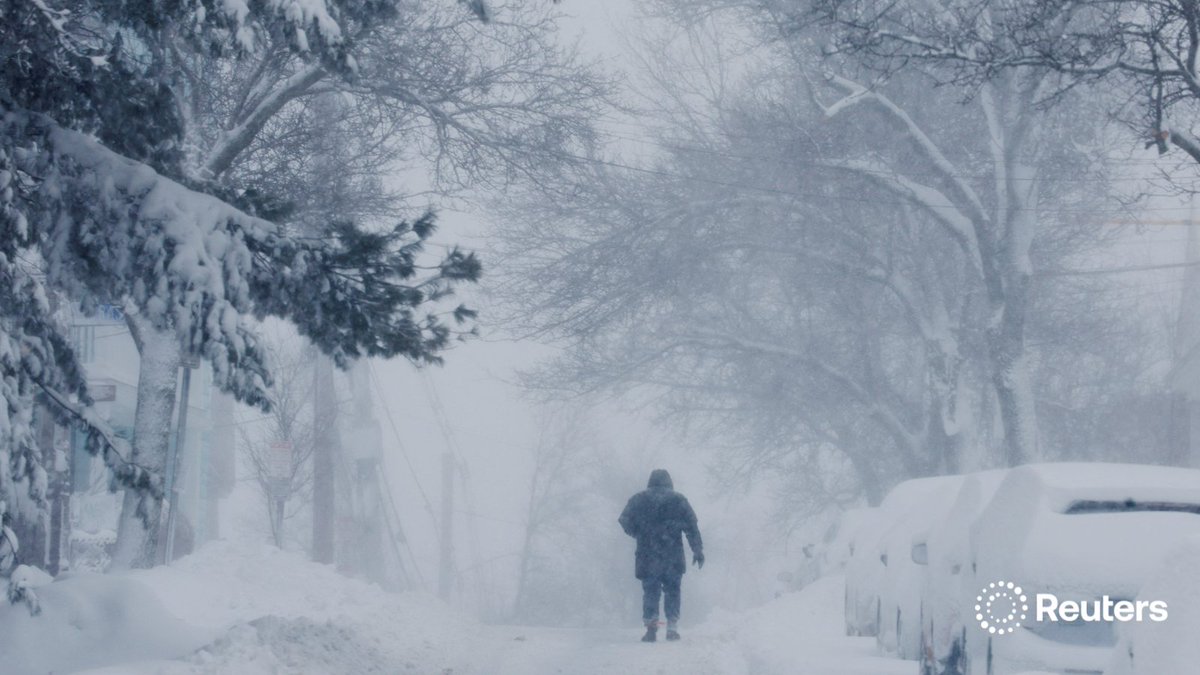
Snow blankets Central Park in New York City amid the storm, as reported by Reuters.
Power outages peaked at over 600,000 customers across the Northeast, with nearly 300,000 in Massachusetts alone. Coastal flooding caused beach erosion up to 20 feet and minor damage along the Jersey Shore; two fatalities occurred in Maryland from a fallen tree.
Meteorologically, the storm underwent explosive cyclogenesis, deepening rapidly off North Carolina to 966 mb, producing thundersnow and rates of 1-2 inches per hour along the Northeast corridor, according to the Wikipedia entry.
As the storm exited into Atlantic Canada on February 24, recovery efforts focused on clearing roads and restoring power, with schools closed in areas like Boston for an additional day.