

Dec. 2, 2025 — Redmond, Wash. The City Council adopted updates to the city’s short-term rental (STR) code through legislation CM 25-475, clarifying licensing requirements, compliance rules, and good-neighbor standards for rentals of fewer than 30 nights.
The changes, effective in part from January 1, 2026, aim to support hosts amid expected demand surges from Seattle’s hosting of 2026 FIFA World Cup matches.
The updates align Redmond’s regulations with state definitions of STRs, excluding hotels, motels, B&Bs, owner-occupied homes renting fewer than three rooms, and rentals of 30 nights or longer.
Hosts must obtain a Redmond Business License or city endorsement, with fees of $153 for 2025 and $160 starting in 2026. Applications involve state processes via Secure Access Washington, followed by city review.
Safety standards, per RCW 64.37.030, require carbon monoxide alarms, annual checklists, and postings for tenant protections. City staff outlined these in a December 11 webinar hosted by the City of Redmond, OneEastside SPARK, and Airbnb.
Speakers, including city staff Kim Dietz and Denise Shinoda, Airbnb’s Scott Brownlee, and Superhost Ambassador Muni Sodhi, covered registration steps, market trends, pricing tools, and preparation for high-demand events.
The webinar addressed Seattle’s six World Cup matches from June 19 to July 6, projecting regional economic boosts and 380,000 Airbnb guests across host cities.
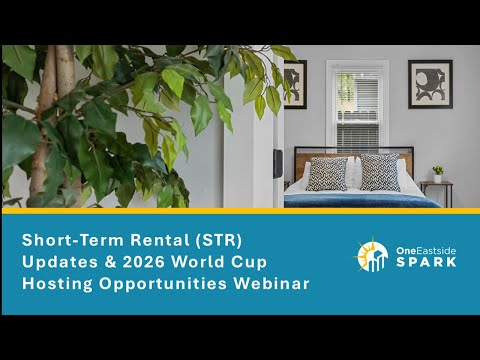
Recording of the Dec. 11, 2025, webinar (YouTube).
A City of Redmond civic alert on December 9 promoted learning resources, while Facebook posts announced the adoption, stating, “at last night’s meeting, City Council adopted updates to the city’s short-term rental code.”
An upcoming in-person session on January 13, 2026, from 11:30 a.m. to 1 p.m. at Redmond City Hall will review the rules and offer hands-on assistance from the same speakers, plus OneEastside’s Shawn Palmer. Registration is available via the city’s opportunities page.
Seattle’s World Cup hosting is expected to draw 750,000 visitors and generate over $1 billion in economic activity, with Redmond leveraging light rail access and promoting local activations.