

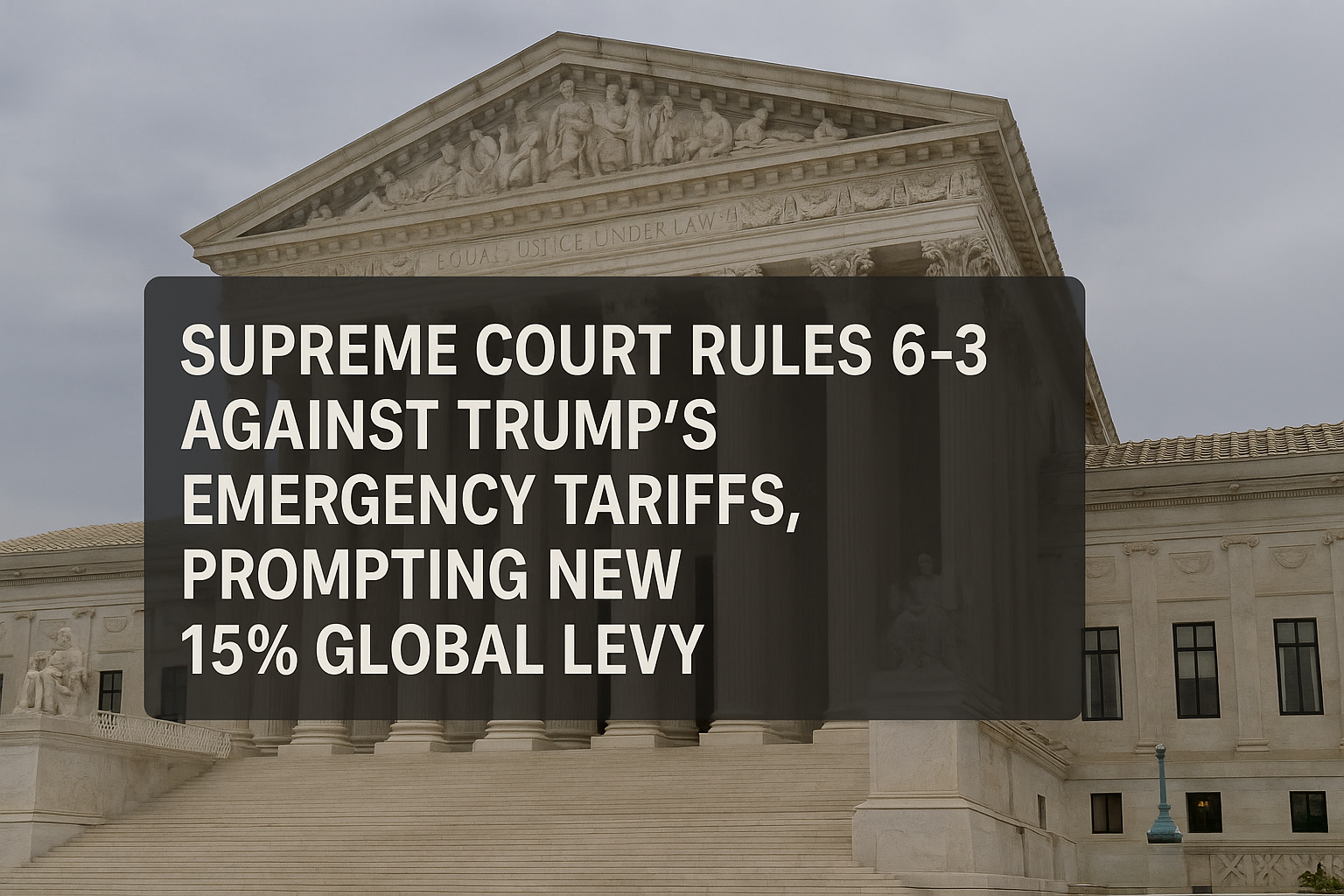
Feb. 20, 2026 — Washington, D.C. The U.S. Supreme Court issued a 6-3 ruling in Learning Resources, Inc. v. Trump (consolidated with Trump v. V.O.S. Selections, Inc.), holding that the International Emergency Economic Powers Act (IEEPA) does not authorize President Trump to impose sweeping tariffs on imports from Canada, Mexico, China and other partners to combat drug trafficking and trade deficits.
Chief Justice John Roberts authored the majority opinion, emphasizing that IEEPA’s language to “regulate . . . importation” does not encompass tariffs, a core congressional power under Article I, Section 8 of the Constitution. The decision struck down these “emergency” tariffs, which collected over $200 billion in 2025, but left refund issues for lower courts.
“Based on two words separated by 16 others in … IEEPA—‘regulate’ and ‘importation’—the President asserts the independent power to impose tariffs on imports from any country, of any product, at any rate, for any amount of time,” Roberts wrote. “Those words … cannot bear such weight.”
Roberts invoked the major questions doctrine, requiring clear congressional authorization for such vast economic actions. Justices Sotomayor, Kagan and Jackson joined the liberals’ textualist approach, while Justices Barrett and Gorsuch concurred in parts. Dissenters Justices Kavanaugh, Thomas and Alito argued IEEPA permits tariffs as a tool to regulate imports during emergencies, warning of refund chaos and trade uncertainty.
President Trump responded swiftly, calling the ruling “deeply disappointing” and labeling the justices “unpatriotic and disloyal to our Constitution” in Truth Social posts. On Feb. 20, he imposed a 10% global tariff under Section 122 of the Trade Act of 1974, raising it to 15% the next day, citing balance-of-payments deficits. U.S. Customs and Border Protection announced it would halt IEEPA tariff collections effective Feb. 24, deactivating related codes (Yahoo Finance live coverage).
The ruling spares other tariffs under Section 232 or 301 authorities (CNN coverage). Markets reacted with caution; U.S. stock futures slipped amid fallout.
US stock futures were largely flat Sunday evening following a ruling by the Supreme Court of the United States that refuted the legality of a key portion of Trump's tariffs. https://finance.yahoo.com/news/live/stock-market-today-dow-sp-500-nasdaq-futures-slip-amid-trump-tariff-fallout-with-iran-us-talks-on-deck-234453634.html
— JC Wandemberg (@Wandemberg72296) February 22, 2026
Kavanaugh’s dissent noted potential billions in refunds, even if costs passed to consumers, creating a “mess.” The decision underscores limits on executive trade powers amid ongoing global uncertainty.