

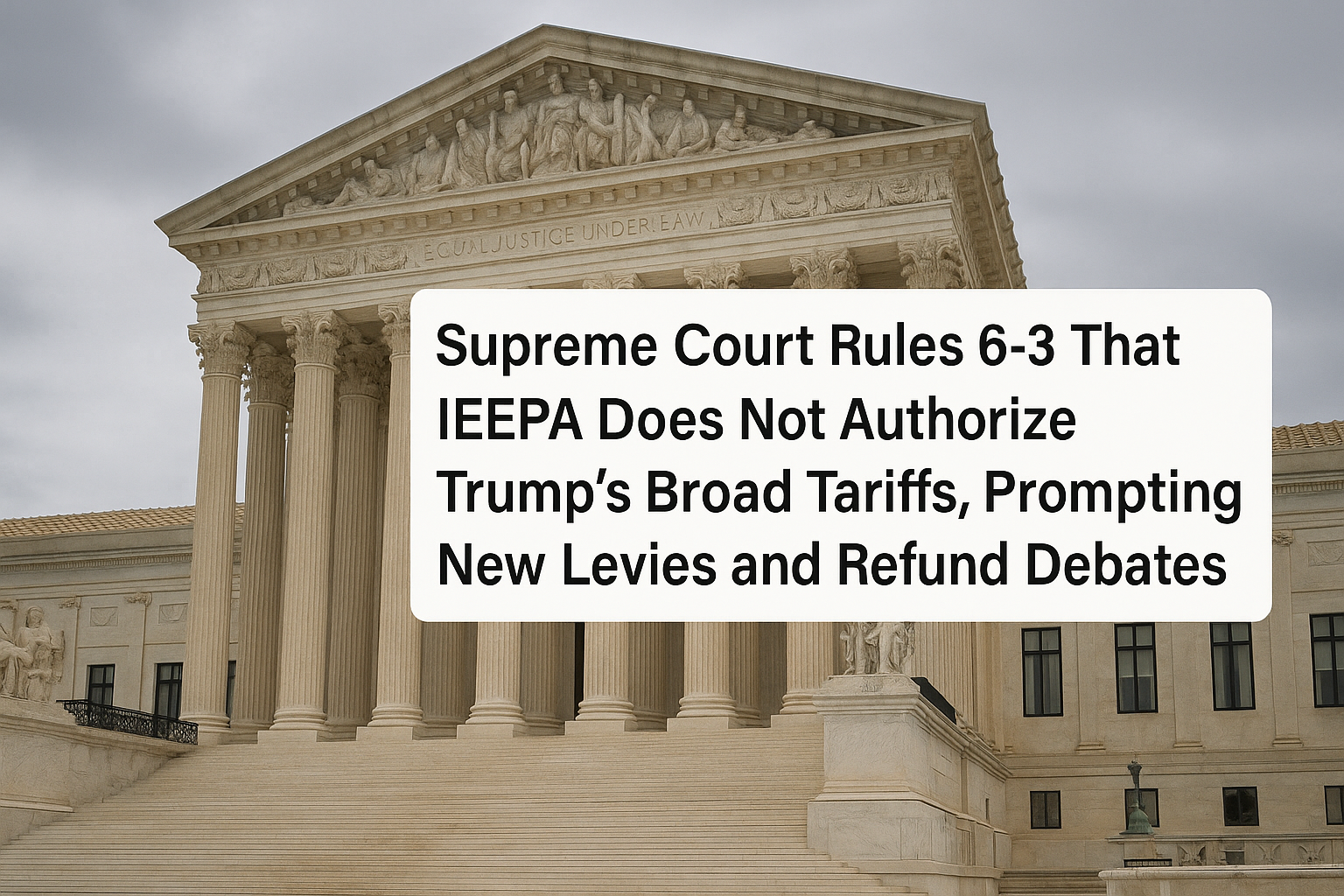
Feb. 20, 2026 — Washington, D.C. The U.S. Supreme Court issued a 6-3 decision in Learning Resources, Inc. v. Trump holding that the International Emergency Economic Powers Act (IEEPA) does not authorize President Trump to impose broad tariffs, invalidating numerous emergency trade levies enacted in 2025 without congressional approval.
Chief Justice John Roberts wrote the majority opinion, joined by Justices Sotomayor, Kagan, Gorsuch, Barrett and Jackson on core holdings. The ruling applied the major questions doctrine, determining that IEEPA’s language to “regulate . . . importation” lacks the explicit terms like “tariff,” “duty” or “tax” needed to delegate such taxing authority to the executive branch.
“The President asserts the extraordinary power to unilaterally impose tariffs of unlimited amount, duration, and scope. In light of the breadth, history, and constitutional context of that asserted authority, he must identify clear congressional authorization to exercise it. IEEPA’s grant of authority to ‘regulate . . . importation’ falls short.” — Chief Justice Roberts, per SCOTUSblog analysis.
The decision struck down tariffs including 25% levies on most Canadian and Mexican imports tied to drug trafficking, 10-20% on Chinese goods, 10% reciprocal tariffs on all imports rising to 145% on China, and others on India for Russian oil imports. Justices Kavanaugh, Thomas and Alito dissented, arguing IEEPA’s regulation includes traditional tools like tariffs.
In response, President Trump held a White House news conference, calling the majority justices “fools and lap dogs” while praising the dissenters, and claimed the ruling would ultimately yield more revenue. Hours later, he imposed a new 10% global tariff under Section 122 of the 1974 Trade Act, effective February 21, later raising it to 15% via Truth Social, with exemptions for certain foods, minerals and USMCA partners Canada and Mexico.
Markets reacted sharply, with the Dow Jones Industrial Average dropping amid trade policy uncertainty, as noted in NYT coverage. The Penn Wharton Budget Model estimated up to $175 billion in potential refunds from roughly $165 billion collected under IEEPA by early 2026. Democrats in Congress pushed for refunds, while importers continue payments pending clarity, per CNBC.
Global outlets highlighted trade disruptions: BBC on uncertainty, NBC News as a blow to the president, and Reuters on Trump’s pivot. Fox News framed it as a major test of presidential powers.
The ruling leaves refund processes unresolved, potentially creating an administrative “mess,” as warned in dissents and oral arguments. Concurrences by Justices Gorsuch, Barrett, Kagan and Jackson emphasized textualism, nondelegation and legislative history over broader doctrines.